

Most Erasmus+ budget problems don’t look like mistakes.
They look like “close enough” calculations that quietly drain value from your project.
Schools don’t usually overspend — they misalign.
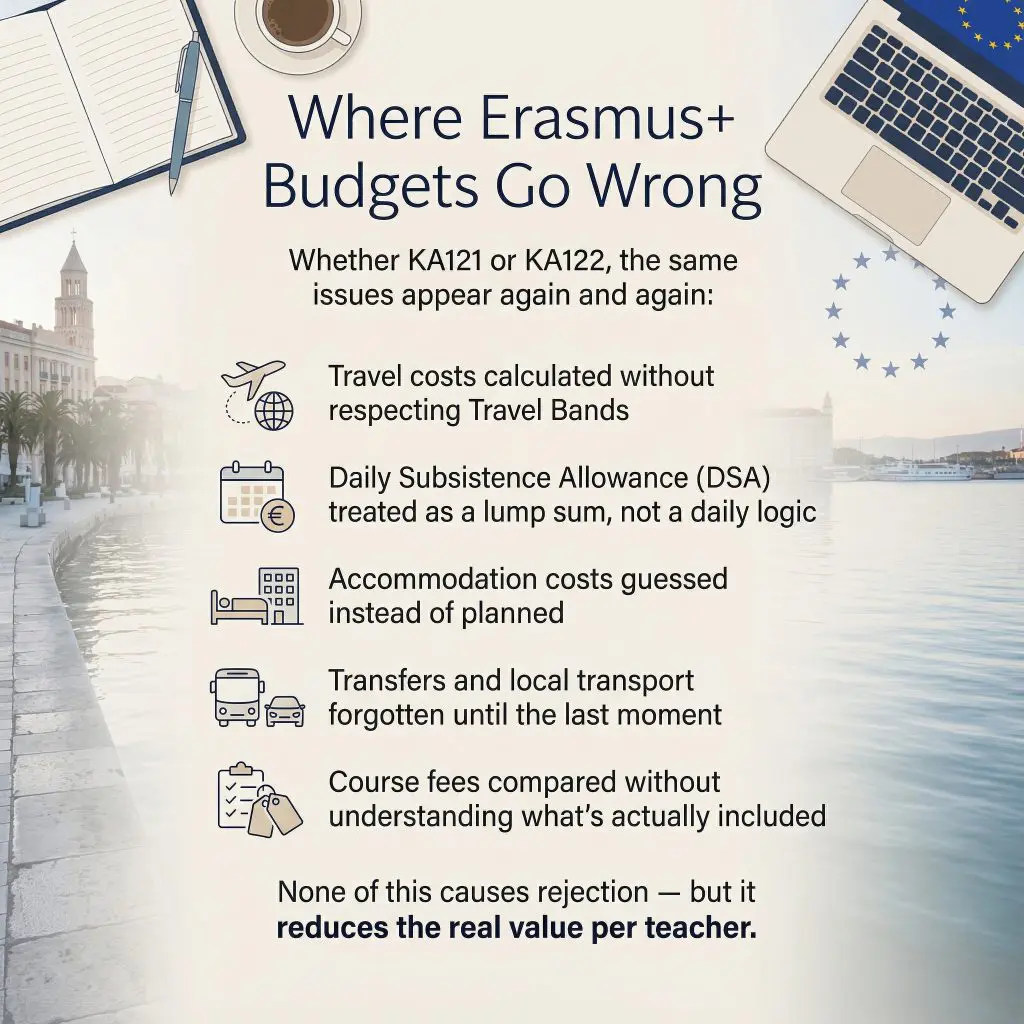
Where Erasmus+ Budgets Go Wrong
Whether KA121 or KA122, the same issues appear again and again:
-
Travel costs calculated without respecting Travel Bands
-
Daily Subsistence Allowance (DSA) treated as a lump sum, not a daily logic
-
Accommodation costs guessed instead of planned
-
Transfers and local transport forgotten until the last moment
-
Course fees compared without understanding what’s actually included
None of this causes rejection — but it reduces the real value per teacher.
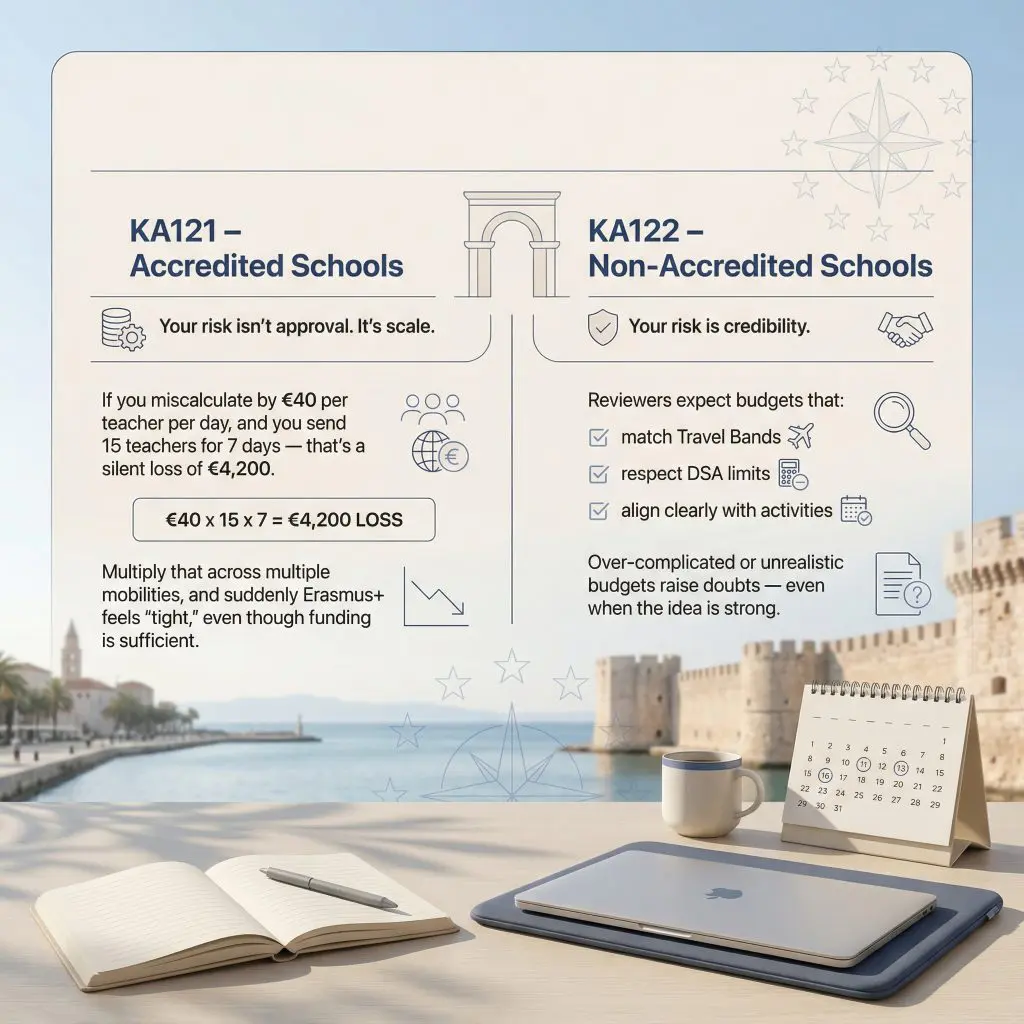
The Two Budgeting Risks (Depending on Your Status)
KA121 – Accredited Schools
Your risk isn’t approval. It’s scale.
If you miscalculate by €40 per teacher per day, and you send 15 teachers for 7 days — that’s a silent loss of €4,200.
Multiply that across multiple mobilities, and suddenly Erasmus+ feels “tight,” even though funding is sufficient.
KA122 – Non-Accredited Schools
Your risk is credibility.
Reviewers expect budgets that:
-
match Travel Bands
-
respect DSA limits
-
align clearly with activities
Over-complicated or unrealistic budgets raise doubts — even when the idea is strong.
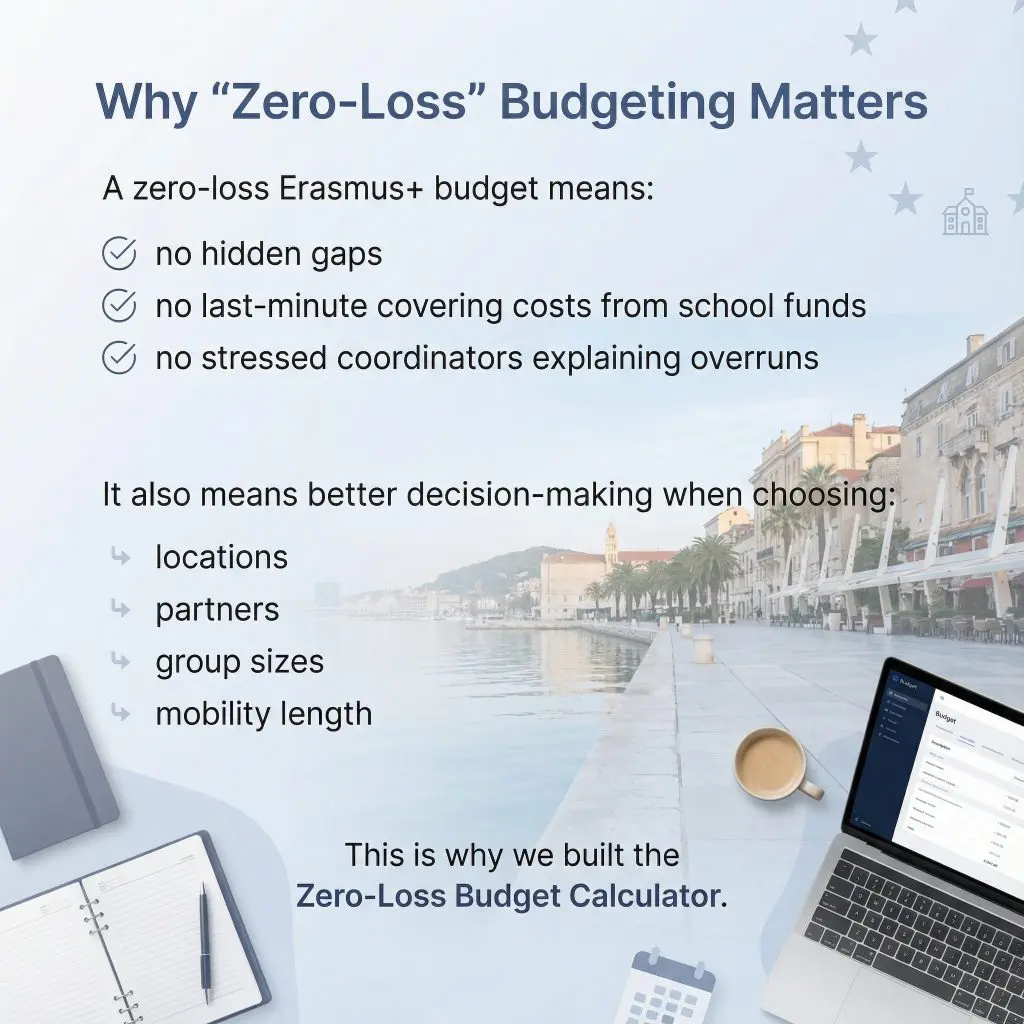
Why “Zero-Loss” Budgeting Matters
A zero-loss Erasmus+ budget means:
-
no hidden gaps
-
no last-minute covering costs from school funds
-
no stressed coordinators explaining overruns
It also means better decision-making when choosing:
-
locations
-
partners
-
group sizes
-
mobility length
This is why we built the Zero-Loss Budget Calculator.
What the Zero-Loss Budget Calculator Does
Our calculator helps schools:
-
match Travel Bands correctly
-
calculate real DSA per teacher per day
-
see how accommodation + transfers affect totals
-
compare providers on true cost, not brochure price
It works for both KA121 and KA122 and is designed for January planning, not last-minute fixes.
To help you navigate the deadline (Feb 19), we have built the Lina Edu Zero-Loss Calculator. But first, you need to understand the three buckets of money you are asking for.
1. Travel (The Distance Band)
The EU pays a flat rate based on distance (e.g., 500-1999km).
-
The Trap: Booking late. If the flight costs €400 but your distance band only gives you €275, you lose money.
-
The Fix: Book early, or use “Green Travel” (train/bus) to trigger higher funding rates and extra travel days.
2. Individual Support (Daily Allowance)
This covers accommodation and food. The rate depends on the country. Croatia is in Group 2 (Medium living costs).
-
The Trap: Choosing a luxury hotel in July (peak season) when your grant is calculated for standard living costs.
-
The Fix: Split is incredibly cost-effective in the “shoulder season” (April/May or October). Our Calculator shows you exactly how far your daily allowance goes in Split during these months.
3. Organizational Support (OS)
This is €100 (Accredited) or €350 (Short-term) per participant. It’s for “admin.”
-
The Trap: Treating this as “profit.” It usually gets eaten up by transfer costs, insurance, and cultural preparation.
-
The Fix: Use a partner who bundles transfers. We can include airport pickups in our packages so you don’t have to touch your OS funds for logistics.
The Solution: The Zero-Loss Calculator
We have built a simple Excel tool pre-loaded with current Split prices and Erasmus+ 2026 rates.
-
Enter your number of teachers.
-
Enter your origin city.
-
See exactly how much grant you will receive vs. the estimated cost of the trip.
Stop guessing. ensure your project is financially viable before you submit.
📩 You can request the calculator via e-mail (info@linaedu.eu) no obligation, just clarity for writing your next Erasmus+ Project.